
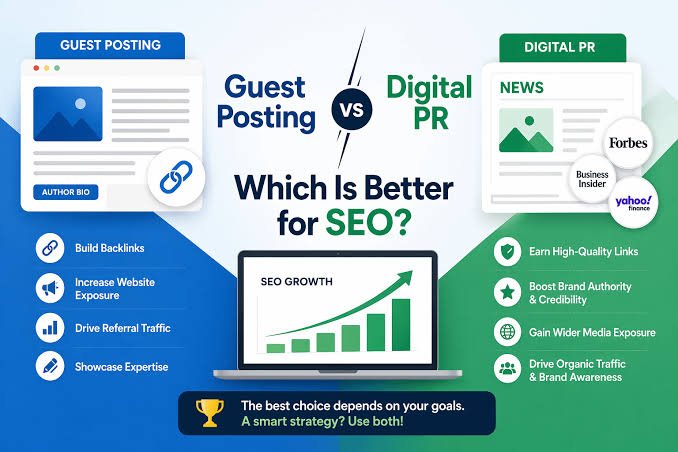
Digital PR vs Guest Posting: Where Your Link Building Budget Should Go
Ask ten SEO agencies how to build links and you will hear two camps. One says guest posting is the reliable workhorse: predictable, scalable and easy to budget. The other says digital PR is the only approach worth doing now: harder, riskier, but capable of earning links no money can buy.
Both camps are partly right. Guest posting and digital PR are not competitors. They are tools for different jobs. The mistake most founders make is spending their whole budget on one because an agency happened to sell it.
What Each Approach Actually Is
Guest posting
You or your agency write an article for another website in your industry. The article includes a link back to your site. Done properly, it is useful content on a relevant site, written by someone with real expertise.
Digital PR
You create a story journalists want to cover, such as original data, a survey, an expert opinion on breaking news or a creative campaign, and pitch it to media. When they cover it, they link to you. The links come from news sites and major publications that rarely accept guest content.
Side by Side
| Factor | Guest posting | Digital PR |
|---|---|---|
| Predictability | High. You know roughly what you will get | Low. Some campaigns land big, some land nothing |
| Link quality ceiling | Moderate. Industry blogs and niche sites | Very high. National news and major publications |
| Control over anchor and page | More control | Little control |
| Brand exposure | Limited | Can be significant |
| Time to results | Weeks | Weeks to months, with gaps between wins |
| Risk | Higher if done at scale on low quality sites | Low for search penalties, higher for wasted spend |
| Best for | Topical relevance and specific pages | Authority, brand recognition and trust |
When Guest Posting Makes Sense
Guest posting still has a place, as long as it is done well. It works best when:
- You need relevance in a specific niche. A link from a respected industry blog tells search engines what your site is about.
- You want to support specific pages. Guest content can point naturally to a relevant guide or service page.
- You have real expertise to share. A genuinely useful article on a well read industry site builds credibility with readers too.
- You need steady, predictable progress. For many businesses, especially in local or niche markets, consistent relevant links move rankings reliably.
Where guest posting goes wrong
The problems start when guest posting turns into a volume game. Google’s spam policies specifically name large scale guest posting campaigns with keyword rich anchor text links as link spam. Warning signs include:
- Sites that publish on every topic imaginable for anyone who pays.
- Sites with impressive authority scores but no real readers.
- Exact match anchor text used again and again.
- Articles written only to hold a link, with no real value.
When Digital PR Makes Sense
Digital PR works best when:
- You need authority at the domain level. Links from major publications strengthen the whole site, not just one page.
- You compete in a crowded market. When competitors all have similar niche links, major media coverage can separate you.
- You have data or expertise worth reporting. Original research, customer insights or expert commentary give journalists something new.
- Brand awareness matters. Coverage puts your name in front of people, and that increases branded searches.
Where digital PR goes wrong
- Weak stories. Journalists ignore pitches that are really advertisements.
- Irrelevant campaigns. A viral stunt unrelated to your business may earn links but does little for your topical authority.
- Unrealistic expectations. A single campaign can fail. Digital PR works over a series of campaigns, not one.
Why AI Search Tilts the Balance
AI search has made brand authority more valuable. When fewer people click through from search results, being recognized and cited as a trusted source matters more. Pew Research found that AI summaries and standard results lean heavily on a small set of trusted sources.
Digital PR builds exactly that kind of recognition: your brand mentioned by publications people and search systems already trust. Quality guest posting on relevant sites still builds topical relevance. Low quality guest posting builds neither.
How to Split Your Budget
There is no universal ratio, but these starting points work for most businesses:
| Business type | Suggested focus |
|---|---|
| Local business or clinic | Mostly relevant local and niche links, with occasional local media PR |
| Early stage SaaS | Mostly quality guest content and partnerships, adding PR once you have data to share |
| Established SaaS or ecommerce brand | Balanced split, leaning toward PR for authority |
| Company with proprietary data | Lean heavily toward digital PR |
Revisit the split every quarter. Shift budget toward whichever approach is producing better links and better business results. AI should support your business goals, not become the goal itself.
How to Judge Results
Do not judge either approach by link count alone. Better measures include:
- Relevance of linking sites to your business.
- Real traffic on linking sites, not just third party scores.
- Ranking movement on the pages and topics you care about.
- Branded search growth, a good signal for PR impact.
- Referral traffic and conversions from the links themselves.
The FounderFeat Take
Guest posting and digital PR are both legitimate when done with quality in mind. Guest posting builds relevance steadily. Digital PR builds authority and recognition in bursts. The strongest link profiles use both.
If your current plan is nothing but bulk guest posts on generic sites, it is time to rebalance. If it is nothing but expensive PR campaigns with sporadic wins, add a steady base of relevant placements. The right answer is almost always a mix.