
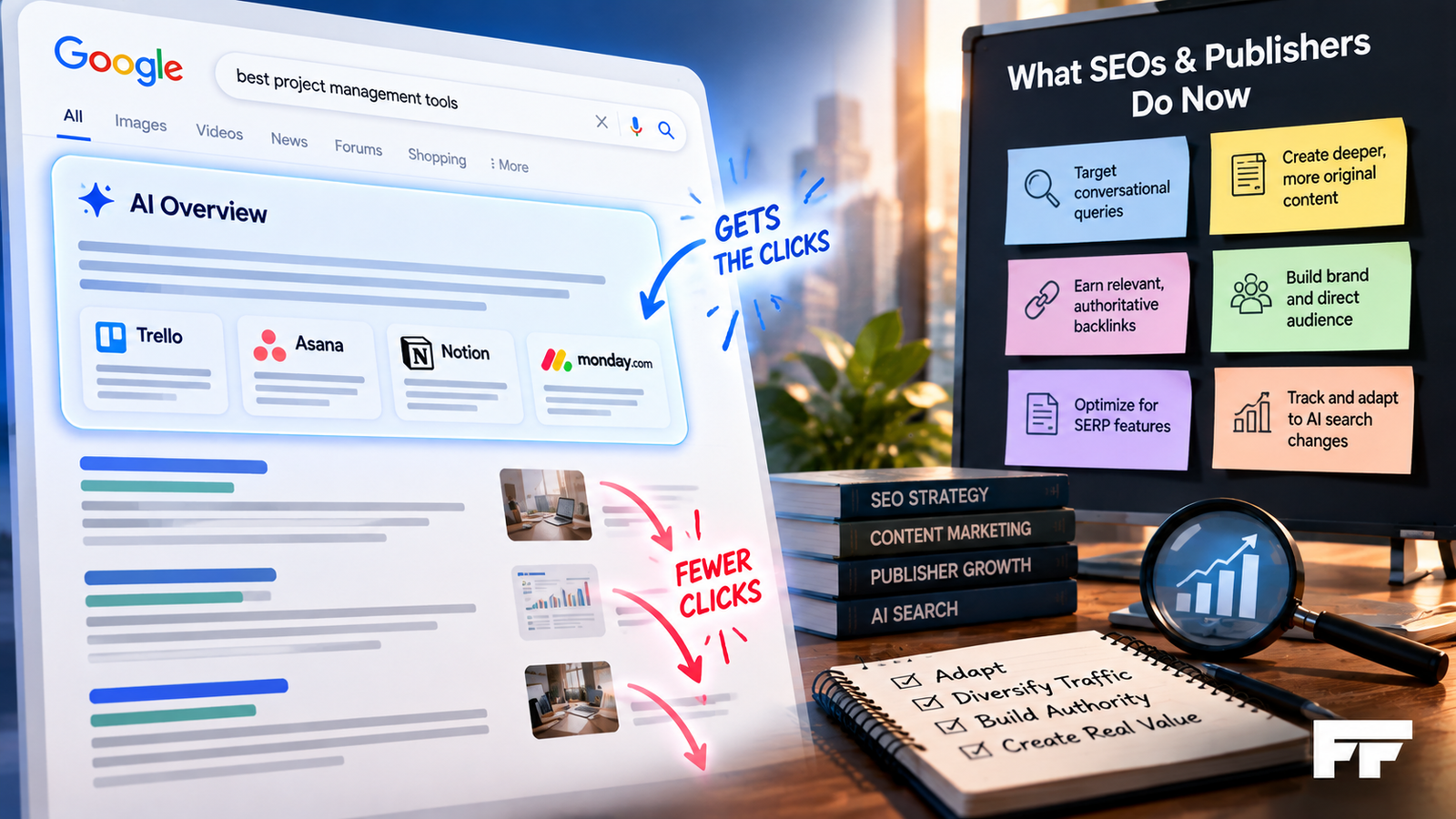
AI Overviews Are Eating Clicks. Here Is What SEOs and Publishers Do Now
If you manage SEO for a business or a publication, you have probably seen the pattern already. Impressions hold steady or even rise. Rankings look fine. Clicks slide. The culprit on many queries is the AI generated answer sitting above the results.
This is a practical playbook for that reality: how to diagnose the impact on your own site, what to change in your content plan, and how to report results honestly when the old metrics stop telling the full story.
The Scale of the Problem
The best independent data comes from Pew Research Center, which tracked the real browsing behavior of 900 US adults in March 2025. Across tens of thousands of searches, users clicked a traditional result in 8% of visits when an AI summary appeared, versus 15% when none appeared. Links inside the AI summary were clicked in just 1% of visits, and users were more likely to end their session entirely after seeing a summary.
Pew is careful to note that this shows an association rather than proof of cause. But it matches what many SEOs see in their own data, and it gives you a benchmark: on affected queries, expect click through rates to fall sharply.
Step 1: Diagnose Your Exposure
Not every site is hit equally. Before changing strategy, find out where the damage actually is.
Segment by query type in Search Console. Group your queries into informational (what, how, why), commercial (best, vs, review) and branded. Compare click through rates across periods for each group. Informational queries are usually hit hardest.
Look for the telltale gap. Pages where impressions are flat or rising but clicks are falling are the clearest sign that an AI answer is satisfying searchers before they reach you.
Check the results page yourself. For your top traffic queries, search manually and note whether an AI Overview appears and whether your site is cited in it.
Separate the causes. Seasonality, lost rankings and technical problems can also cause declines. Rule them out before blaming AI features.
Step 2: Rethink What Each Page Is For
Once you know which pages are affected, assign each a clear job.
| Page type | Old job | New job |
|---|---|---|
| Simple informational answers | Drive traffic | Build topical authority and earn citations |
| In depth guides | Drive traffic | Drive traffic from people who want depth, then convert them |
| Comparisons and reviews | Capture buyers | Capture buyers, now more valuable than ever |
| Original research | Earn links | Earn links, citations and brand recognition |
| Product and service pages | Convert | Convert, largely unaffected |
This framing stops teams from panicking about traffic drops on pages that were never going to drive revenue directly.
Step 3: Publish What an Overview Cannot Replace
AI summaries are good at restating widely available facts. They are poor substitutes for:
- First hand experience: real testing, real case studies, real photos and results.
- Original data: surveys, benchmarks and analysis nobody else has.
- Expert judgment: clear recommendations from someone with visible credentials.
- Tools and templates: calculators, checklists and downloadable resources people need to use, not just read.
- Depth for decisions: detailed comparisons for people about to spend money.
Shift production away from short explainer content and toward these formats. Fewer pages, each more useful, tends to outperform volume in this environment.
Step 4: Optimize to Be Cited
Being cited in an AI summary sends limited clicks, but it builds visibility and trust. Google’s own guidance on AI features says the same SEO best practices apply, with no special markup required to appear. In practice, that means:
- Answer the core question clearly near the top of the page.
- Use descriptive headings that match how people phrase questions.
- Keep facts accurate and up to date, with a visible “last updated” date.
- Show who wrote the content and why they are qualified.
- Earn mentions and links from sources search systems already trust.
Step 5: Capture the Visitors You Still Get
If fewer people click, each visitor is worth more. Make sure you are not wasting them.
- Add a clear next step on every page: a newsletter sign up, a free tool, a related guide or a product trial.
- Improve internal linking: guide readers from informational pages to commercial ones.
- Speed up the site: a slow page loses the few visitors who did click.
- Build an email list: subscribers are traffic you own, independent of search changes.
Step 6: Change How You Report
Traditional SEO reports lead with sessions and rankings. In an AI search world, those can mislead. Add these measures:
- Impressions and visibility alongside clicks, so stakeholders see reach even when clicks fall.
- Conversions from organic search, which matter more than raw traffic.
- Branded search volume, a sign that visibility is building recognition.
- Citations in AI answers for your priority topics, checked manually or with tracking tools.
- Revenue per organic visitor, which often rises as low intent clicks disappear.
Be upfront with clients or leadership about why traffic is falling. Explaining the Emerging markets startups shift early builds far more trust than defending a declining chart later.
What to Stop Doing
- Stop publishing thin content at scale. Pages that simply restate common answers are exactly what AI summaries replace.
- Stop chasing every keyword. Focus on topics where you can offer genuine depth or experience.
- Stop judging SEO by traffic alone. Traffic without conversions was never the real goal.
The FounderFeat Take
AI Overviews are not the end of SEO, but they are the end of easy informational traffic. The winning strategy now looks less like publishing volume and more like publishing proof: experience, data and expertise that a summary cannot copy.
SEOs who adapt their content, measurement and reporting will keep delivering value. Those who keep optimizing for the old click model will spend the next year explaining falling charts.